

Meet Nico, Our New Board President
Meet Nico Meyering, Disability Pride Pennsylvania's new board president. He's a fixture in Philadelphia's disability community, where he chairs the Philadelphia Mayor's Commission on People with Disabilities, and leads the fight for quality transportation. Notably, he led the fight against SEPTA service cuts, including a 24-hour ride to protest them. His day job is deployment success manager at FreedomPay, a payment technology company, but his heart is with disability justice. He lives in Philadelphia with his wife, Ariele.
Disability Pride Pennsylvania sat down with Nico to talk about his vision, his path to advocacy, and what comes next.
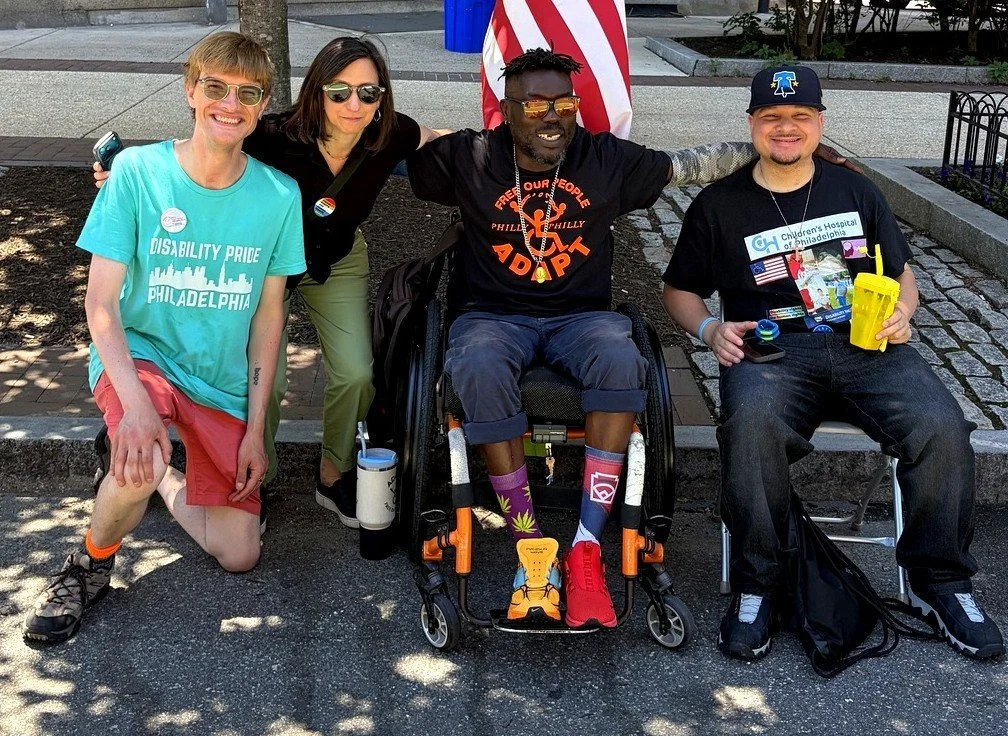
This sunny outdoor group photograph shows four smiling individuals posed closely together. Nico is far left, wearing a blue Disability Pride Philadelphia T-shirt.
Q: What is your vision for Disability Pride Pennsylvania?
A: One thing that I really focus on in my disability activism is making sure everybody succeeds, or gets something out of the result that we're pursuing. The old motto is "nothing about us without us," not "nothing about me without me," although it can be that as well. And I think one thing that I've been lucky enough to have in my life from birth is an active disability community, and that's something that I really want everybody in Pennsylvania to also have, if they want it.
Disability rights and disability pride belongs at every table in Pennsylvania. We belong in every conversation. Why? Because we know what it's like when we're not at every table. We know what it's like when we're not in every conversation. We need to be in it.
Seventeen percent of Philadelphians age 18 or over have at least one disability. If you look nationwide at voters with a disability, that's 1 in 6 American voters. If you add in our nuclear family and friends, then it becomes 1 in 3 American voters, 33% of us. That's powerful numbers, man. It's incredible numbers.
Q: Your mother, Dr. Mary Vanderlaan, was your first and most fierce advocate. Can you tell me about her influence on you?
A: My mother was the first person in her family to go to college and was the first woman to chair the department at the college that she taught at for her entire professional career. But more importantly, she was also the person who, when she understood that I was going to have this disability for life, really confronted her fear and her sorrow and her confusion head-on by finding other families with kids with CCHS, getting us together in a group to advocate for each other, support one another.
I remember helping her staple together paper copies of the newsletter for the CCHS Family Network. And then we would assemble all the pages, staple the packet, drop the packet into the manila envelope, and then make sure that we didn't put the return label upside down by accident. Because I was, like, 5, that was a real risk, you know?
And I could tell you a hundred stories about how mom fought tooth and nail to make sure that families were heard. And to make sure that doctors would hear us. The same old white men doctors who wouldn't listen to her because she didn't have a medical degree, right, just a PhD, they ignored her at their own peril, really.
My mother's skill and natural talent at building community inspires me and motivates me to do the same for Disability Pride Pennsylvania.
Q: Talk about your journey to becoming an advocate
A: For a long time, because how I got my start was helping my mother with the CCHS Family Network, I thought that advocacy was just, like, me hanging out with my friends or me helping my friends. But I began to realize that advocacy is a skill that you can hone and is a tool you can use in numerous situations when I first moved out of my childhood home after college.
I was living in this apartment that I could barely afford, and I hadn't figured out the public transit schedule yet. It was January, February back in 2011, and, well, major snowstorms were still a thing. So, I'm walking back from this job interview that I had, and I had misread the bus schedule, and I duck into this church basement because there was a sandwich board advertising free hot meals.
I found out that I had come too early for the food, and it was just one guy setting up the day before the meal. But I still had got a place out of the storm and a place to warm up, and I got to learn about this resource that I took advantage of because I was in need at the time.
So I came back the next day for the community meal, and I remember thinking, probably after I finished my bowl of stew, "I really want to make sure that this is here for the next person." So I kind of showed up week after week at that free community meal, helping to set out the dishes beforehand, helping to clean up, whatever my schedule really looked like.
I stayed with the organization Food Not Bombs up until I went to grad school, so for about a year and a half. I took the reins on recruiting more volunteers, sourcing other food providers, and expanding our menu. And that was an education that college wouldn't give me. And that was an education that grad school ultimately wouldn't give me.
I think my leadership style is, we want to all succeed together, and that requires building consensus. But the tension we have to hold is that we do have to act. We have to act decisively, and we have to act for the good of all.
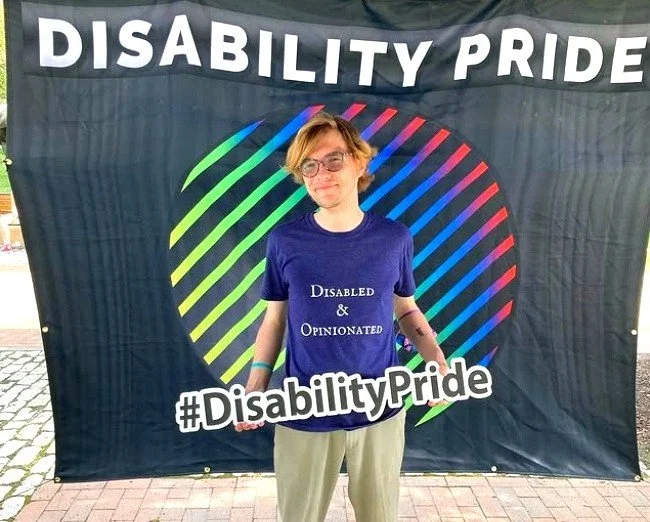
Nico is wearing a blue T-shirt saying “Disabled & Opinionated.” He’s also holding a sign saying #DisabilityPride while posing in front of a Disability Pride banner.
Q: You've been deeply involved in Philadelphia's fight against SEPTA service cuts. Why does transit access matter so much to disability advocacy?
A: Public transit is a necessity for a lot of disabled Americans and for a lot of disabled Pennsylvanians as well. And that's just by virtue of how the commonwealth is laid out.
It's ridiculous that SEPTA's waitlist for all its accessibility upgrades is 12 years long. In 12 years we could have four Star Wars films and three different Spider-Men, but evidently we can't have accessible public transit.
Q: You chair the Philadelphia Mayor's Commission on People with Disabilities. What's one win from that work you're most proud of?
A: One of the recent wins that we had with the Mayor's Commission is at the end of April this year, we had a disability summit at Inglis Innovation Center. And at that summit, we had things like an accessible dance workshop, tours of the Accessible Technology Lab, an employment panel, and a civic engagement panel that I moderated. That panel put disabled voters in a face-to-face situation with a city council member.
Q: What's it like living with CCHS, and how has it shaped the way you lead?
A: My disability is called congenital central hypoventilation syndrome, or CCHS, and there's about 2,000 cases worldwide, so it's pretty rare. Well, I have to rely on machinery to keep me alive. Reliance and interdependence is a necessary part of survival. And that's true for myself, but it's also true for the disability community here in Pennsylvania. We all rely on each other. And one thing I learned from living with CCHS is that we show up for each other. We make sure that we have all the resources that we really need. And we do what has to be done.
I will say that any of the victories that we have for Disability Pride Pennsylvania, I'd like to dedicate to all my disabled friends, CCHS and non-CCHS disabled friends who have unfortunately lost their lives prematurely. To be disabled in America in 2026 is to know very keenly how unfair and unjust life is. And then also to recognize why we move forward still, and why we keep momentum and keep the progress going still. You miss them like hell, though, don't you? You miss them like hell.
Q: What advice would you give someone who's newly disabled or just starting to find their voice as an advocate?
A: For someone who is newly disabled, I would say that every emotion you feel about being disabled is completely understandable and valid. And nobody gets to talk about what you're experiencing and what you're feeling except you.
My advice for someone who is just starting out as an advocate would be to find one cause that really speaks to them. What is it about you? What's important about your life that only you can speak to, and only you can speak about? And I think that once you find that, that's the basis you can build off of.
And you know what, brand-new activist, brand-new advocate, I'm really interested in what you have to say, and I can't wait to see what you do next.
