

How Disabled Organizers Built Modern Transit Advocacy
By Nico Meyering, Board Member (Independent opinion piece)
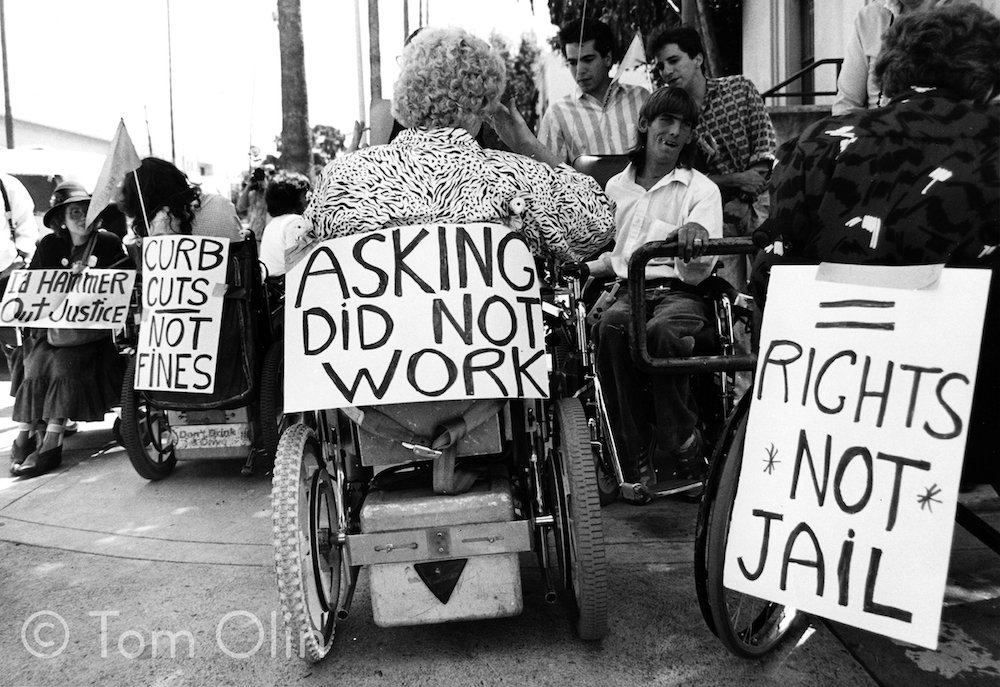
Image above: From the Gang of 19 in Denver to a bus stop audit in Harrowgate Park, the campaign for accessible transit has always been the campaign for better transit.
---
There's a small hydraulic sound most Philadelphians never register. It's the ramp deploying on a SEPTA bus. For me and over 200,000 Philadelphians, that sound means freedom.
Nineteen people in Denver had to block two buses for 24 hours to make that sound exist.
I've thought about that fact since early June, when I did my first bus station accessibility audit with Transit Forward Philadelphia at Harrowgate Park with a clipboard, a tape measure, and a list of questions about whether a bus stop was accessible. That Saturday I was testing the coalition's bus stop accessibility audit process, which is just a fancier way of saying I spent three hours asking very involved questions about bus stops. Is the bus stop sign legible? Is there enough room for a bus to deploy its ramp? Is there anywhere to sit while you wait?
None of those questions were new. That's what kept surfacing, stop after stop. Disabled organizers have been asking them since before I was born. They just had to ask from the middle of an intersection, with their bodies, because nobody would answer any other way.
Accessible transportation is our birthright
Denver, July 5, 1978
On the day after the Fourth of July in 1978, a group of activists from the Atlantis Community rolled in front of a Regional Transportation District bus at Colfax and Broadway in downtown Denver. A second bus on the same route pulled up behind them. More protesters surrounded that one too. Traffic in the center of the city stopped and stayed stopped.
They held the intersection for roughly 24 hours. At night, some of them left their wheelchairs and slept on the asphalt. They chanted "We will ride." Their signs read "Access is a civil right" and "taxation without transportation."
The math behind the protest was ugly and simple. Denver had recently ordered a fleet of new buses, and almost none of them could carry a wheelchair user. By one account from the Colorado Virtual Library, only 10 of RTD's 213 buses had any wheelchair access at all. The Atlantis Community, organized with Rev. Wade Blank, had already sued over this in 1977 and lost. The 19 people in the street were what came after losing in court.
It worked. The appeal settled, and RTD agreed to put wheelchair lifts on its fleet. Denver became one of the earliest American cities with accessible mass transit, and it happened because a group of disabled people made themselves physically impossible to ignore.
They became known as the Gang of 19. Five years later, in 1983, they went national and founded ADAPT. The acronym originally stood for American Disabled for Accessible Public Transit. Buses were the entire reason the organization existed.
Get a taste of what the Gang of 19 accomplished from this Rocky Mountain PBS clip.
The bus decade, 1983 to 1990
Between its founding in 1983 and the passage of the ADA, ADAPT ran more than 20 major protest actions in cities across the country. They weren't going after a single transit agency. Their targets were the American Public Transit Association and the Urban Mass Transportation Administration, the federal body that's now the Federal Transit Administration.
Their strategy stayed consistent to anyone watching. Wheelchair users would box in a bus front and back. Others would leave their chairs and drag themselves up the steps of an inaccessible vehicle, in public, so the barrier couldn't be waved off as an abstraction.
In October 1983, ADAPT organized around APTA's national convention in Denver, circulating a flier that invited wheelchair users from every state to demand the right to board every public bus in the nation. The convention crowd included the Secretary of Transportation, the sitting Vice President, and a presidential candidate. Whatever else you want to call ADAPT, it isn’t naive about where power sits.
The most famous action came on March 12, 1990. The ADA had been introduced, revised, and left to stall. ADAPT gathered at the White House to launch what they called the Wheels of Justice March and moved down to the west front of the Capitol. There, dozens of activists left their wheelchairs, crutches, and walkers at the base of the steps and climbed the marble stairs on their hands, forearms, and elbows.
Jennifer Keelan was 8 years old. She said she'd take all night if she had to.
The next day, roughly 150 protesters occupied the Capitol Rotunda, chained their wheelchairs together, and chanted "Access is a civil right." More than a hundred were arrested. The New York Times called the images striking, and noted, correctly, that they were meant to be.
President George H.W. Bush signed the Americans with Disabilities Act on July 26, 1990, four months later.
Victorious, ADAPT changed focus. It became Americans Disabled for Attendant Programs Today, and the fight shifted toward community based attendant services and against institutionalization. From their perspective, we’d won the transit fight at the federal level
Here's the part I want transit professionals to sit with. A national movement built itself around buses, won a federal accessibility mandate, and then moved on to the next emergency — leaving the implementation to the rest of us.

Young Jennifer Keelan was 8 when she participated in the iconic Capitol Crawl to help push the ADA over the finish line.
Philadelphia's unfinished list
Start with scale. Roughly 17 percent of Philadelphians over 18 report at least one disability, which works out to somewhere near 245,000 adults.
That's not a niche constituency. It's larger than the population of Allentown.
SEPTA's own accounting is that every bus in its five county service region is accessible, and that the system has more than 100 accessible stations.
The bus half of the ADA worked. The rail half is a different story, and to SEPTA's credit, they're honest about it.
In October 2025, the authority cut the ribbon on an accessibility project at Tasker-Morris, which brought the Broad Street Line to just over half of its stations being fully accessible. Susquehanna-Dauphin was finished in 2023, at a cost of roughly $24 million for one station. Erie Station became the first station accessibility project in the country to reach construction using the Federal Transit Administration's All Stations Accessibility Program, a fund created in the 2021 Infrastructure Investment and Jobs Act and co-authored by then-Sen. Bob Casey specifically to help the nation's oldest rail systems catch up.
When SEPTA adopted its Fiscal Year 2025 capital budget, it projected roughly $1.4 billion in station accessibility investment over 12 years, aiming for the day every Broad Street Line, Market-Frankford Line, and trolley trip runs through an accessible station. At the time, that figure sat at 61 percent.
Hold onto that number. We're coming back to it.
What the ADA actually promised about transportation
Title II of the ADA covered public transportation, and on buses it actually kept its word. New fixed route buses purchased after 1990 had to be lift or ramp equipped, full stop. That one requirement is why every SEPTA bus you could name is boardable today.
Rail got a loophole instead of a deadline. The statute gave transit agencies three years to make "key stations" accessible, but let the Secretary of Transportation stretch that window to thirty years for stations needing expensive structural changes. According to the Bureau of Transportation Statistics, the ADA never set any statutory deadline for full fleet accessibility, period.
Read that again. A civil rights law passed in 1990 built in a thirty year escape hatch for rail stations. That's why, thirty six years later, a Philadelphian can ride a fully accessible bus straight to a subway station they can't enter.
What a coalition does with this history
Transit Forward Philadelphia launched in 2020 as a coalition of Philadelphia-based organizations pushing for a transit network that's equitable, accessible, safe, and sustainable. Its flagship campaign, Better Access Better Service Better Buses, is built on plain operational facts: SEPTA buses average under 12 miles per hour for most of the day, and more than half of them arrive at fifteen minute headways or worse.
Here's what I've watched the coalition actually do, and why I think it's worth studying.
Transit Forward Philadelphia brought disabled organizations in as members and experts rather than advisory afterthoughts. Liberty Resources and Disabled In Action sit inside the coalition, not outside it offering comments. That distinction sounds procedural. It isn't. It decides whose priorities survive the agenda-setting meeting.
Transit Forward Philadelphia hires disabled workers and puts disabled speakers in front of the rooms where transit decisions actually get made. It actively elicits more disabled input; as a Disability Pride PA board member and Transit Forward Philadelphia steering committee member, I was honored to help Disability Pride PA join the coalition earlier this summer.
“Audits are how lived experience becomes
admissible evidence.”
Critically, it does the unglamorous documentation work. Coalition partners run accessibility audits of bus and trolley stops all over the city. My own first one was that Saturday at Harrowgate Park in early June. Others have covered ground from Kensington to Southwest Philly, including one that kicked off outside the Blanche A. Nixon / Cobbs Creek Library. The method is always the same. You walk the corridor, you measure, you photograph, you write down what's broken, and at the end you've got something an agency or a city council committee can't just wave away.
Audits are how lived experience becomes admissible evidence.
The coalition ran the same playbook on intercity buses. After Greyhound closed its terminal at 1001 Filbert Street in 2023, riders got pushed to a temporary site on Spring Garden with no shelter from rain, heat, or snow, limited restroom access, one segregated wheelchair pickup spot, and a nearby Market-Frankford station with no elevator. Transit Forward Philadelphia and its partners handed out water on hot days, testified at City Council, and ran an accessibility audit. In 2026, a fully ADA compliant intercity terminal opened back up at 1001 Filbert.
That took three years of unglamorous pressure. Nobody had to crawl up any steps this time. What was left was the follow through.
Access is the Stress Test
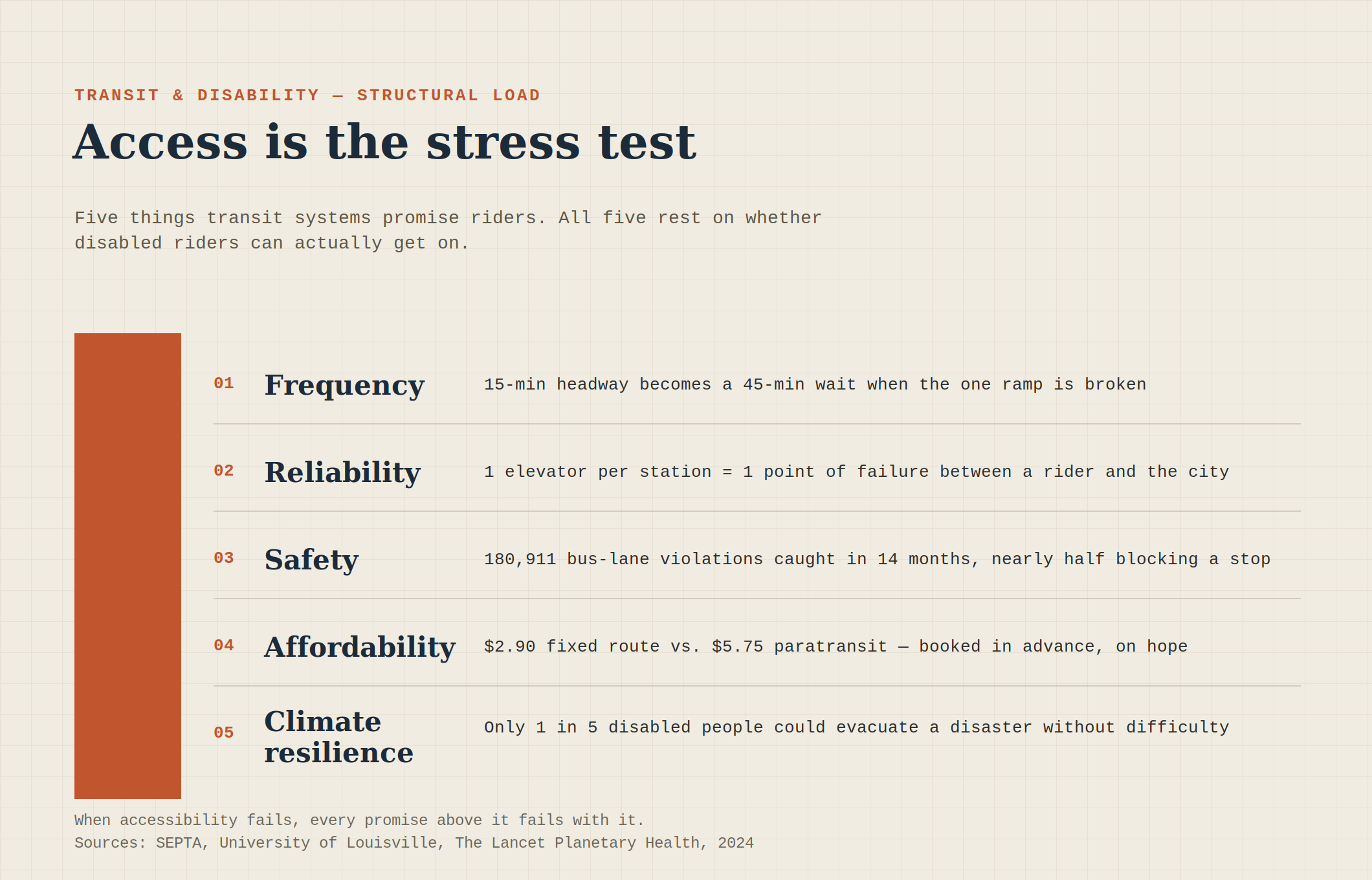
Here's the most useful thing I can offer transportation professionals reading this: accessibility isn't a line item that sits next to affordability, frequency, reliability, safety, and climate resilience. It's the stress test all five of those have to pass.
Frequency. If you use a wheelchair and you hit a broken ramp, your real wait isn't eight minutes anymore. It's however long until you find a working ramp or a detour. Low frequency multiplies every access failure that exists. A fifteen-minute headway can quietly turn into forty five for a Disabled rider, and that gap is sometimes the difference between keeping a job and losing one.
Reliability. A subway station with exactly one elevator has exactly one point of failure between a rider and the rest of the city. For most people, an outage is annoying. For some of us, it's a closed station.
Safety. SEPTA's own 2023 study found more than half the bus stops along the 21 and 42 routes were obstructed at some point during a typical weekday, some as much as 30% of the time. We now have citywide proof of how common that obstruction really is: AI-powered cameras on SEPTA buses and trolleys captured 180.911 violations between May 2025 and June 2026, nearly 89,500 of them vehicles caught in no-stopping bus lanes, generating $14.5 million in fines. A bus that can't pull to the curb can't land its ramp properly, full stop.
Liberty Resources built a national campaign around bus stop safety, citing University of Louisville research showing 73 percent of transit bus wheelchair incidents happen while the bus is stopped, most of them on the ramp or lift itself or on the sidewalk right before or after boarding. Clearing those lanes isn’t just about safety: SEPTA says the cameras are already cutting down travel time by 3 to 6% on equipped routes. A parked car at a bus stop is a safety hazard, and now we have receipts to prove it
Affordability. Disabled Philadelphians are disproportionately low income, in a poor city with an expensive transit system. SEPTA fare is $2.90 one way, and an ACCESS trip is a $5.75 one way trip you have to schedule in advance and hope they show up.
Climate resilience. This is where the sustainability field is furthest behind. Research published in The Lancet Planetary Health in 2024 cites an international survey finding that only about one in five disabled people could evacuate a disaster immediately without difficulty, and that 76 percent of states don't mention Disabled people in their climate adaptation policies at all. Michael Ashley Stein, at Harvard Law School's Project on Disability, has written that disabled people are two to four times more likely to die or be injured in climate emergencies. An accessible, frequent transit network is climate infrastructure. It's how people without cars get out of a flood zone, and how people without air conditioning get to a cooling center.
Philadelphia is a city of rowhomes, brick, and asphalt, and it holds heat like a cast iron skillet. Any serious heat plan here, whether anyone wants to admit it or not, is a transit plan.
The budget math nobody wants to say out loud
Now back to that 61 percent.
In 2025, SEPTA faced a $213 million structural deficit. In June, its board approved a budget with 45% service cuts and a 21.5% fare increase. Cuts began August 24. A Common Pleas judge ordered them halted on August 29, following a lawsuit arguing the cuts disproportionately harmed riders of color and lower-income riders. In September, with PennDOT's approval, SEPTA shifted up to $394 million out of its capital budget and into operations. Service came back on September 14.
I was relieved. Most riders were. But here's what SEPTA wrote in its own amended budget document about what that maneuver actually cost: long planned accessibility improvements at more than a dozen stations will be deferred indefinitely, and service cuts could return as early as Fiscal Year 2028.
I keep coming back to that sentence. Philadelphia kept its buses running by postponing its elevators.
I don't think SEPTA made the wrong call, for what it's worth. Given two bad options, they picked the one that kept nearly a million daily trips intact. I think the choice itself is the indictment. A transit system shouldn't have to trade this year's service against next decade's access, and a civil rights obligation shouldn't be the most deferrable line on anyone's balance sheet.
This is why the statewide fight matters. Transit for All PA, which grew out of 2021 conversations convened by Pittsburghers for Public Transit with the Amalgamated Transit Union, Philly Transit Riders Union, Clean Air Council, and Transit Forward Philadelphia, has built a coalition of tens of thousands of riders and workers in every legislative district in the Commonwealth. Its legislative package has drawn more than forty co-sponsors across both chambers.
A transit system shouldn't have to trade this year's service against next decade's access, and a civil rights obligation shouldn't be the most deferrable line on anyone's
balance sheet.
And it just took another hit. Governor Shapiro signed Pennsylvania's $50.8 billion budget on July 12, and for the fifth year running, it includes zero dollars for transit operations. The coalition had organized riders to send more than 50,000 letters to lawmakers this year alone, reaching every legislative district in the Commonwealth. Those calls went largely unanswered. "We've been left out for far too long," Connor Descheemaker, the campaign's statewide manager, said after the signing.
State Sen. Nikil Saval put it more plainly: the General Assembly deferred action again, and, in his words, "We will once again face this issue in 2027." Riders in the Lehigh Valley are bracing for route eliminations on top of fares LANTA already raised. Lancaster County paratransit riders get hit with another fare increase next month. Even Shapiro's own watered-down proposal — a 1.75% share of sales tax revenue for transit — couldn't get through the legislature, and Transit for All PA says it would have landed $92 million short of what's actually needed anyway. The same budget found $775 million in new money for state highways.
None of that is a Philadelphia story. All of it is the same story, wearing a different county's name.
What I keep thinking about on the 42
The Gang of 19 weren't transit planners. Most of them had recently gotten out of nursing homes. They didn't have a model, a dashboard, or a communications strategy. What they had was a bus in front of them and the conviction that a public system built to exclude them wasn't actually public.
Everything after that is implementation. ADAPT organized a decade of bus actions into a national movement. That movement made the ADA passable. The ADA made the ramp mandatory. And then it fell to coalitions, agencies, city councils, and people with clipboards on Saturday mornings to close the distance between what the law says and what the corner of your block actually looks like.
Transit Forward Philadelphia treats that distance as the work, not as a specialty interest bolted onto the real agenda. It's a strategic choice, not a sentimental one: a network that works for a ventilator user, a blind rider, a parent with a stroller, and someone hauling groceries home from the Acme is simply a better network for everybody riding it. The curb cut argument has been made for 50 years, and it's still true. Accessibility is the design constraint that keeps everything else honest.
I'm hopeful about Philadelphia, and I want to be careful about why. Not because the funding fight is going well — it isn't. I'm hopeful because the organizing model here has genuinely changed. Disabled people aren't being invited to comment on transit decisions after they've already been made. In this coalition, we're in the room where the campaign gets designed, and that's a fundamentally different thing.
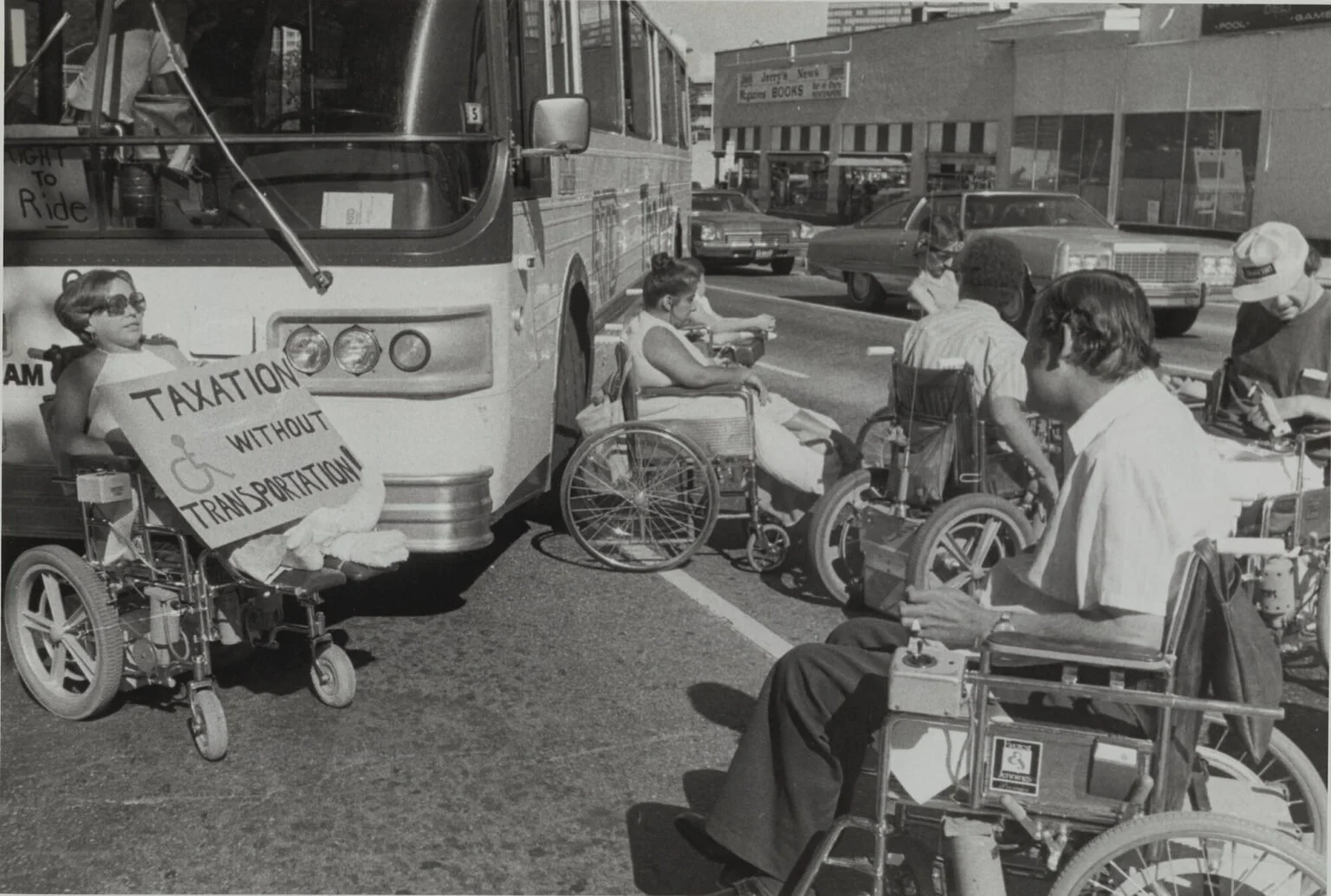
The "Gang of 19" blocked those buses for a full day, changing their city and nation for the better by making accessible transportation a reasonable expectation.
When do you involve disabled people?
If you work in transportation, planning, sustainability, or local government, here's the question I'd actually like answered, because I don't think there's one right answer.
In your agency, your coalition, or your city, at what point in the process do Disabled people enter the room? And what would change if they entered one step earlier?
I'd rather read your honest answer than a good one. Contact Disability Pride PA to share it.