

Voting in Pennsylvania has never been easier. Not too long ago, our only choice was to show up at a poll on Election Day. I used to be so jealous of all the states that had early voting, and when COVID brought mail-in ballots with it, I gave it a try.
Now, I almost always vote by mail.
This year, given all the noise about possible interference with state voting rolls, I wondered if I should use a drop box or over-the-counter voting instead.
This was me at the post office:
Hey, ummmmm … I’ve been hearing that the feds want to give you the power to decide whose ballots to deliver. That makes me kind of nervous about whether my ballot will be counted.
Nice Lady Behind the Counter: I haven’t heard anything like that. We send them right down as we get them.
Me: Oh, OK. Here.
I gave her my ballot, paid for postage and waited nervously for the email that it was received. A few days later, the county let me know they got my ballot and that was that.
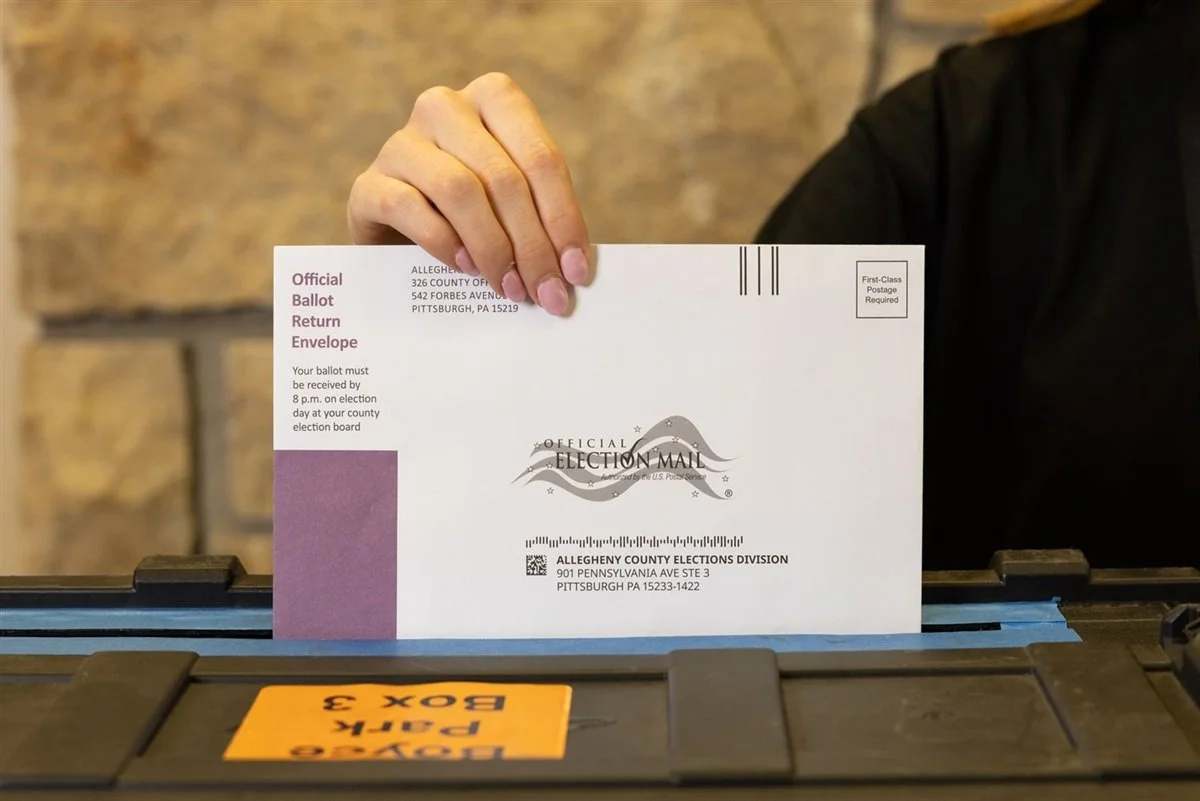
In addition to mailing in a ballot, voters can use drop boxes conveniently located throughout their county, like the one in this photo.
Hopefully you have already voted, too. But if you haven’t, there is still time to come up with a voting plan for next Tuesday’s election.
Consider Volunteering
Even though I already voted, I will still be at the polls. As a Democratic committeewoman for Brentwood, a small borough adjacent to Pittsburgh, I’ve signed up for a shift to greet voters. It’s a small thing I can do to help educate voters interested in knowing who our local party’s endorsed candidates are.
I first became an elected Democratic committeewoman around 15 years ago in Dauphin County when I lived in Harrisburg and quickly learned it’s an excellent way to get to know what my neighbors care about so I can share with our candidates. And vice versa.
Being part of the Dauphin County Democratic Committee was thrilling, as we focused on candidates dedicated to improving education, housing, health care and strengthening civil rights. I was a small part of the large team and learned that it is very easy to make a difference in the political party of your choice. Essentially, you just have to show up, put in some volunteer hours, and many doors open for you. This allows you to amplify your concerns.
There are other ways to make an impact as well, of course. Voting and letting your elected officials know who you voted for and why is extremely important. There are also phone calls and emails and in-person meetings. But volunteering lets you build direct relationships with your preferred candidates.
Don’t Call It Pennsyltucky
Pittsburgh has roughly six times as many people as Harrisburg, and Allegheny County has more than four times as many as Dauphin. I spent the first half of my life in Pittsburgh and am tickled to finally be back home.
I rankle when I hear “Pennsyltucky,” and I want to say emphatically that yes, Harrisburg IS a city.
Yet it can fit in Pittsburgh’s back pocket.
Nowhere was this made more clear to me than the first Allegheny County Democratic Committee endorsement meeting I attended.
In Dauphin, we gathered at the Harrisburg Hilton or at AFSCME, or someplace similar. We all know each other, and voting is by acclamation. We caucus by township or ward to endorse local candidates, and it’s a nice time. I have mad respect for all members of DCDC, as they’ve pulled off some generational wins.
In Pittsburgh, there are too many of us committee people to gather in a room together. Instead, we show up at the IBEW in Southside, with our photo IDs, and vote in a formal process. The sidewalks are lined with candidate tents vying for our votes, and it feels like a carnival. The line to vote snakes outside the building and up the sidewalk.
It’s exciting and daunting and amazing!
If I were in Harrisburg right now, I’d be biting my fingernails, making phone calls and knocking on doors for our candidate who’s poised to pull off a major upset.
Here in Pittsburgh, my party dominates. There will be no upsets this year. It’s hard not to feel cocky, which is a mistake.
Outside of Pennsylvania’s main cities, battles are raging for votes and attention. We have a chance to restore Medicaid funding, Section 504 regulations, disability employment goals and claw back some of the freedoms lost over the past two years, if enough of us vote.
If we vote in landslide numbers for candidates who also want these things, it will send a message to politicians to never touch Medicaid again, ever. And our demands for quality, affordable health care for all must be heeded.
If.
